 English
Type of T-Shirt Printing Available in Market.
Aug 29, 2026
Type of T-Shirt Printing in Market
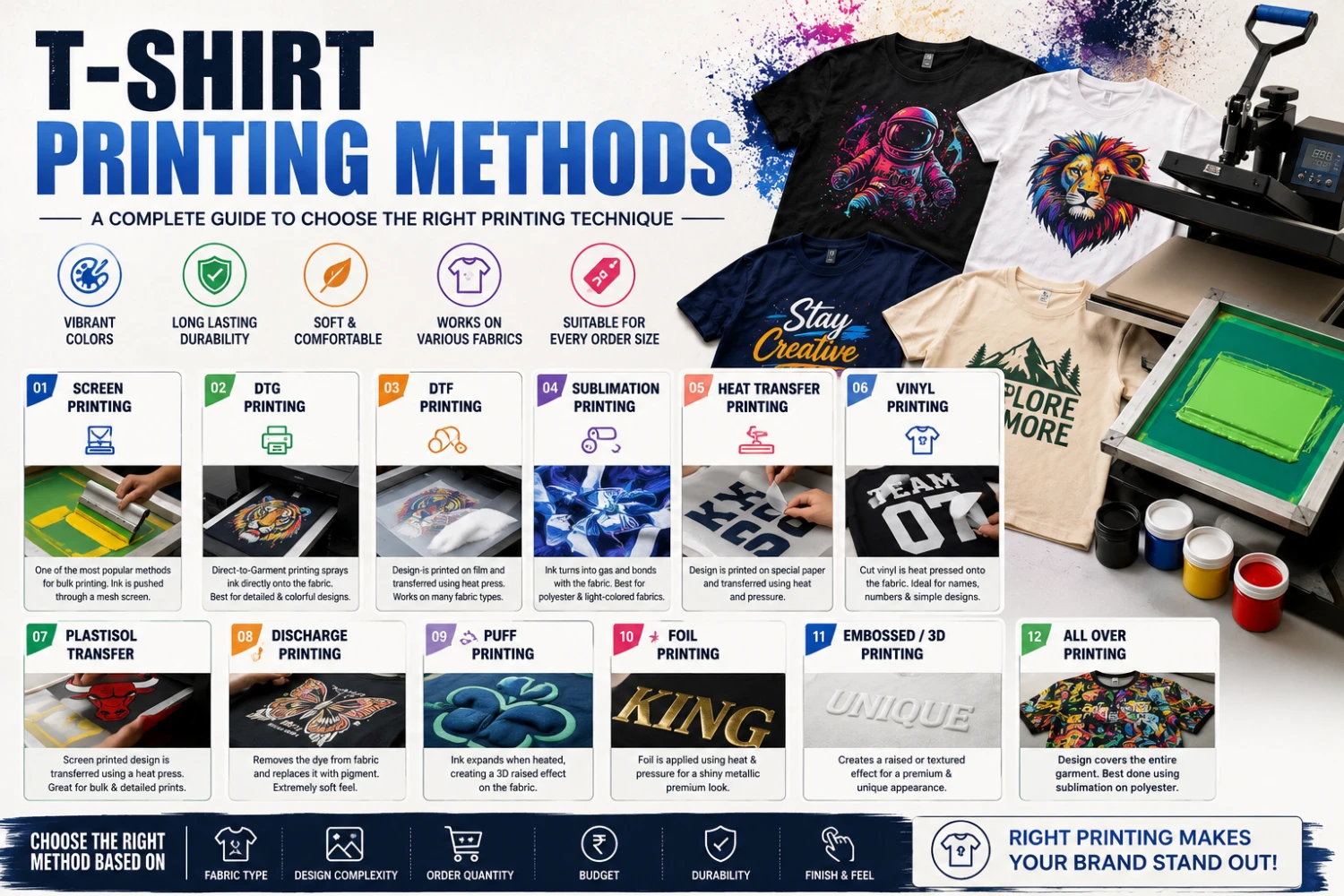
Different Types of T-Shirt Printing Methods: Complete Guide to T-Shirt Printing Techniques
T-shirts are one of the most popular clothing products in the world. From custom brand merchandise and corporate uniforms to sports jerseys, promotional clothing, and fashion streetwear, printed T-shirts are used for almost every purpose.
However, not every T-shirt printing method is the same. Different printing techniques offer different levels of durability, color quality, texture, production speed, and cost. Choosing the right printing method depends on factors such as fabric type, order quantity, design complexity, number of colors, and the desired finish.
In this complete guide, we will explain the different types of T-shirt printing methods, how each method works, its advantages and disadvantages, and when you should use it.
What Is T-Shirt Printing?
T-shirt printing is the process of applying a design, logo, artwork, text, or graphic onto a T-shirt or other garment.
Depending on the printing technique, the design may be printed directly onto the fabric, transferred using heat, applied through a screen, or printed onto special paper or film before being transferred to the garment.
The most popular T-shirt printing methods include:
1. Screen Printing
2. Direct-to-Garment (DTG) Printing
3. Direct-to-Film (DTF) Printing
4. Sublimation Printing
5. Heat Transfer Printing
6. Vinyl Printing
7. Plastisol Transfer Printing
8. Discharge Printing
9. Puff Printing
10. Foil Printing
11. Embossed and 3D Printing
12. All-Over Printing
Let's understand each method in detail.
________________________________________
1. Screen Printing
Screen printing is one of the oldest and most widely used T-shirt printing methods. It is especially popular for bulk T-shirt printing because it offers excellent durability and can be cost-effective for large quantities.
In this method, a mesh screen is prepared for each color in the design. Ink is pushed through the screen onto the T-shirt using a squeegee. Multiple screens are used when the design contains multiple colors.
How Screen Printing Works
The basic process includes:
• Preparing the artwork
• Separating the colors
• Creating screens
• Applying ink through the screens
• Curing the printed T-shirt
• Quality checking and packing
Advantages of Screen Printing
• Excellent durability
• Vibrant colors
• Suitable for bulk orders
• Cost-effective for large quantities
• Works well on cotton fabrics
• Wide variety of ink finishes available
Disadvantages
• Setup cost can be higher
• Not ideal for very small orders
• Complex multi-color designs can require more setup
• Photographic designs may require advanced techniques
Best For
Screen printing is ideal for:
• Bulk T-shirt orders
• Brand merchandise
• Corporate T-shirts
• Event T-shirts
• School and college uniforms
• Promotional T-shirts
• Simple logos and graphics
________________________________________
2. DTF Printing – Direct-to-Film
DTF printing, or Direct-to-Film printing, has become one of the most popular modern T-shirt printing methods.
In DTF printing, the design is printed onto a special PET film using specialized textile inks. A layer of adhesive powder is applied to the printed film. The design is then transferred onto the T-shirt using a heat press.
One of the biggest advantages of DTF printing is that it can work on a wide range of fabrics.
How DTF Printing Works
The typical process is:
1. Create the artwork
2. Print the design onto DTF film
3. Apply hot-melt adhesive powder
4. Cure the powder
5. Position the film on the T-shirt
6. Heat press the design
7. Peel the film
8. Final curing and quality inspection
Advantages of DTF Printing
• Works on cotton, polyester and many blended fabrics
• Excellent for detailed designs
• Bright and vibrant colors
• Suitable for small and large orders
• No screen setup required
• Good for custom names and logos
• Excellent for complex artwork
• Can print white ink for dark garments
Disadvantages
• Printed area can have a slightly raised feel
• Large solid prints may feel heavier
• Requires proper curing and pressing
• Print quality depends heavily on film, powder, ink and machine quality
Best For
DTF printing is excellent for:
• Custom T-shirts
• Small business orders
• Personalized T-shirts
• Brand logos
• Detailed graphics
• Streetwear designs
• Custom names and numbers
• Cotton and polyester garments
________________________________________
3. DTG Printing – Direct-to-Garment
DTG stands for Direct-to-Garment. Instead of transferring a design from another material, a DTG printer directly sprays textile ink onto the T-shirt.
It works somewhat like a conventional inkjet printer, except that it prints directly onto fabric.
DTG is particularly popular for highly detailed artwork and photographic designs.
How DTG Printing Works
The T-shirt is placed onto a printing platen. The garment may be pre-treated, particularly for dark fabrics. The printer then applies the design directly to the fabric. After printing, the garment is cured using heat.
Advantages
• Excellent detail
• Great for photographs
• Smooth print feel
• Unlimited color combinations
• No screen setup
• Suitable for one-off designs
• Excellent for complex artwork
Disadvantages
• Generally slower than screen printing for bulk orders
• Requires specialized equipment
• Works best with suitable garments
• Pretreatment may be necessary
• Production cost can be higher for some applications
Best For
DTG is ideal for:
• Detailed artwork
• Photographic prints
• Custom T-shirts
• Small orders
• Artist merchandise
• Personalized apparel
• Premium cotton garments
________________________________________
4. Sublimation Printing
Sublimation printing is extremely popular for sportswear, jerseys, activewear, and polyester garments.
Unlike many other printing methods, sublimation ink becomes part of the polyester fabric rather than sitting as a thick layer on top.
The artwork is first printed onto sublimation paper and then transferred onto polyester fabric using heat and pressure.
How Sublimation Printing Works
The basic process is:
1. Create the artwork
2. Print it onto sublimation paper
3. Position the paper on polyester fabric
4. Apply heat and pressure
5. Ink changes into gas
6. The ink bonds with polyester fibers
7. Remove the transfer paper
Advantages
• Excellent color reproduction
• Highly durable
• No heavy print layer
• Breathable finish
• Excellent for sportswear
• Allows all-over designs
• Great for gradients and detailed graphics
Disadvantages
• Primarily suitable for polyester or polyester-rich fabrics
• Usually unsuitable for standard cotton T-shirts
• Best results are generally achieved on light-colored fabrics
• Requires specialized sublimation equipment
Best For
Sublimation is particularly suitable for:
• Sports jerseys
• Football jerseys
• Cricket jerseys
• Running T-shirts
• Cycling jerseys
• Polyester T-shirts
• All-over printed garments
• Team uniforms
________________________________________
5. Heat Transfer Printing
Heat transfer printing involves printing a design onto a special transfer material and then transferring it onto the T-shirt using heat and pressure.
It is commonly used for custom apparel and smaller orders.
The design can be transferred using different types of transfer papers, films, or specialty materials.
Advantages
• Good for small quantities
• Easy customization
• Suitable for names and numbers
• No complicated screen setup
• Can produce detailed designs
• Useful for on-demand printing
Disadvantages
• Some transfers may have a noticeable print layer
• Durability depends on transfer material and application
• Large prints may reduce garment breathability
• Quality varies significantly between transfer materials
Best For
• Custom T-shirts
• Names and numbers
• Small orders
• Promotional clothing
• Personalized garments
• Short-run production
________________________________________
6. Vinyl Printing
Vinyl printing, commonly called heat transfer vinyl (HTV), uses colored vinyl sheets that are cut into specific shapes or letters using a cutting machine.
The unwanted vinyl is removed, and the remaining design is heat-pressed onto the T-shirt.
How Vinyl Printing Works
• Create the design
• Cut the vinyl
• Weed the excess material
• Position the design
• Heat press it onto the garment
Advantages
• Excellent for names and numbers
• Strong and durable
• Sharp edges
• Great for text and simple logos
• Available in many finishes
• Suitable for personalization
Specialty vinyl can provide finishes such as:
• Metallic
• Glitter
• Reflective
• Fluorescent
• Matte
• Glossy
• Holographic
Disadvantages
• Not ideal for highly detailed images
• Large designs can feel heavy
• Multiple colors require additional work
• Less suitable for photographic artwork
Best For
Vinyl printing is commonly used for:
• Sports jerseys
• Player names
• Jersey numbers
• School uniforms
• Teamwear
• Personalized T-shirts
________________________________________
7. Plastisol Transfer Printing
Plastisol transfer printing is similar to screen printing, but instead of printing directly onto the garment, the design is screen-printed onto special transfer paper.
The design can then be heat-pressed onto the T-shirt when required.
Advantages
• Good print quality
• Strong durability
• Useful for on-demand application
• Easy storage of prepared transfers
• Suitable for bulk production
Disadvantages
• Requires transfer preparation
• Can have a raised feel
• Requires heat-press equipment
• Production involves additional steps
Best For
• Uniforms
• Promotional apparel
• Logos
• Bulk apparel
• Custom garments
________________________________________
8. Discharge Printing
Discharge printing is a specialized screen-printing technique primarily used on cotton garments.
Instead of simply placing ink on top of the fabric, discharge printing uses a special chemical formulation to remove or deactivate the garment's existing dye in the printed area. Pigment may then be added to create the desired color.
The result can be a very soft print that feels almost like part of the fabric.
Advantages
• Extremely soft hand feel
• Excellent for premium cotton garments
• Minimal print buildup
• Comfortable for large designs
• Great for fashion apparel
Disadvantages
• Requires specialized inks and expertise
• Results can vary depending on garment dye
• Not suitable for every fabric
• More technically demanding
Best For
• Premium fashion T-shirts
• Streetwear
• Vintage-style garments
• High-quality cotton apparel
________________________________________
9. Puff Printing
Puff printing is a specialty printing technique that creates a raised, three-dimensional effect on the T-shirt.
A puff additive is mixed with the ink. When the printed ink is heated during curing, it expands and creates a raised surface.
Advantages
• 3D appearance
• Unique texture
• Eye-catching designs
• Excellent for fashion brands
• Creates premium-looking graphics
Disadvantages
• Not ideal for extremely fine details
• Requires careful curing
• Raised prints may require special care
• More specialized than standard printing
Best For
• Streetwear
• Fashion brands
• Logos
• Typography
• Premium T-shirts
• Graphic designs
________________________________________
10. Foil Printing
Foil printing creates a shiny metallic appearance on garments.
A special adhesive or printing layer is applied to the T-shirt, followed by foil material. Heat and pressure transfer the foil to the garment.
Popular foil effects include:
• Gold
• Silver
• Metallic
• Holographic
Advantages
• Premium appearance
• Shiny metallic finish
• Excellent for fashion designs
• Eye-catching graphics
Disadvantages
• Not ideal for every design
• Requires additional processing
• Foil can be less durable than some conventional printing methods
• Requires proper application and care
Best For
• Fashion T-shirts
• Premium apparel
• Logos
• Event clothing
• Decorative designs
________________________________________
11. Embossed and 3D Printing
Embossed or 3D effects are used to create a raised or textured appearance on garments.
Depending on the production technique, these effects may be created using specialty inks, heat-applied materials, or other garment decoration processes.
Advantages
• Unique texture
• Premium appearance
• Strong visual impact
• Excellent for logos and branding
Disadvantages
• More expensive than basic printing
• Requires specialized production
• Not suitable for every artwork
Best For
• Premium clothing
• Streetwear
• Brand logos
• Luxury apparel
• Limited-edition collections
________________________________________
12. All-Over Printing
All-over printing covers a large portion—or sometimes the entire surface—of the garment with artwork.
Sublimation is one of the most common technologies used for all-over printing on polyester garments.
Instead of having a small logo or graphic in the center of the T-shirt, the design can extend across the front, back, sleeves, and other areas.
Advantages
• Full garment customization
• Excellent for sportswear
• Unlimited design possibilities
• Great for colorful patterns
• Suitable for custom team jerseys
Disadvantages
• Requires specialized equipment
• Production can be more complex
• Fabric selection is important
• Not all fabrics are suitable
Best For
• Sports jerseys
• Team uniforms
• Custom fashion
• Printed sets
• Graphic apparel
• Promotional clothing
________________________________________
Screen Printing vs DTF vs DTG vs Sublimation
Choosing the correct printing method can be confusing. Here's a simple comparison:
Printing Method Best Fabric Best For Durability Ideal Quantity
Screen Printing Cotton, blends Bulk orders Excellent Medium to Large
DTF Printing Cotton, Polyester, Blends Detailed designs Excellent Small to Large
DTG Printing Cotton Photographic designs Good to Excellent Small to Medium
Sublimation Polyester Sportswear & all-over prints Excellent Small to Large
Vinyl Most suitable garments Names, numbers & logos Excellent Small to Medium
Heat Transfer Various Custom designs Good to Excellent Small to Medium
Discharge Cotton Soft premium prints Excellent when properly applied Medium to Large
Puff Printing Various 3D fashion designs Good Small to Large
Foil Printing Various Metallic designs Moderate to Good Small to Medium
________________________________________
Which T-Shirt Printing Method Should You Choose?
There is no single printing method that is best for every T-shirt.
Your choice should depend on several factors.
1. Fabric Type
Fabric is one of the most important factors.
For example:
Cotton T-shirts:
Screen printing, DTG, DTF and discharge printing can be excellent options.
Polyester T-shirts:
Sublimation, DTF and certain heat-transfer techniques are commonly used.
Sportswear:
Sublimation and DTF are popular choices depending on the garment and design.
________________________________________
2. Quantity
If you need hundreds or thousands of identical T-shirts, screen printing can be highly efficient.
For smaller quantities or individual customized designs, DTF, DTG or heat-transfer methods may be more practical.
________________________________________
3. Design Complexity
Simple one- or two-color logos are excellent candidates for screen printing.
Highly detailed artwork, photographs, gradients and multiple colors may be better suited to DTF or DTG.
________________________________________
4. Desired Finish
Think about how you want the print to look and feel.
For a soft premium finish, consider DTG or discharge printing.
For a raised design, puff printing may be suitable.
For a metallic effect, foil printing is an option.
For a seamless colorful sportswear design, sublimation can be ideal.
________________________________________
How to Choose the Best T-Shirt Printing Method for Your Brand
If you are starting a clothing brand, selecting the correct printing method can significantly affect your product quality and production cost.
Consider these questions:
Do you need bulk production?
Choose screen printing for many identical designs, especially when cost efficiency is important.
Do you need highly detailed designs?
Consider DTF or DTG printing.
Are you producing sports jerseys?
Sublimation printing is one of the most popular choices for polyester sportswear and all-over designs.
Do you need custom names and numbers?
DTF or vinyl printing can be suitable depending on the design and fabric.
Do you want a premium streetwear look?
Consider screen printing, puff printing, discharge printing, DTF, or specialty finishes depending on the artwork.
________________________________________
Factors That Affect T-Shirt Printing Cost
The price of printing a T-shirt depends on more than just the printing method.
Important factors include:
• Number of T-shirts
• Number of print locations
• Print size
• Number of colors
• Fabric type
• T-shirt quality
• Artwork complexity
• Printing method
• Finishing requirements
• Packaging
• Production timeline
For example, a 1-color screen print on 500 T-shirts may have a very different cost structure from a full-color DTF print on 20 T-shirts.
________________________________________
How to Make T-Shirt Prints Last Longer
Regardless of the printing technique, proper garment care can help extend print life.
Washing Tips
• Turn the T-shirt inside out before washing.
• Use a gentle washing cycle.
• Avoid extremely hot water.
• Avoid harsh bleaching chemicals.
• Do not scrub the printed area aggressively.
• Avoid excessive heat during drying.
Ironing Tips
Avoid directly ironing over printed artwork. If ironing is necessary, turn the garment inside out or use an appropriate protective layer.
Following proper care instructions can help maintain the appearance of printed garments for longer.
________________________________________
T-Shirt Printing for Clothing Brands
For clothing brands, choosing a printing technology should be based on the brand's product positioning, design style, fabric selection, order volume, and budget.
A streetwear brand may use a combination of screen printing, DTF, puff printing, and specialty effects.
A sportswear manufacturer may primarily use sublimation printing for polyester jerseys.
A customized apparel business may prefer DTF, DTG, and heat-transfer printing because these technologies are suitable for smaller orders and personalized designs.
Many professional apparel manufacturers use multiple printing technologies rather than relying on only one method.
________________________________________
Conclusion
T-shirt printing has evolved significantly, giving clothing brands, manufacturers, businesses, sports teams, and individuals many options to create customized apparel.
Screen printing remains a popular choice for high-volume production. DTF printing is versatile and excellent for detailed designs across different fabrics. DTG printing is particularly useful for highly detailed artwork and photographic prints. Sublimation printing is widely used for polyester sportswear and all-over designs.
Specialty techniques such as puff printing, foil printing, discharge printing, vinyl printing, and 3D effects can add unique textures and finishes to garments.
The best printing method ultimately depends on your fabric, design, quantity, budget, and desired finish.
If you are ordering T-shirts for a clothing brand, sports team, business, event, or promotional campaign, understanding these printing methods will help you choose the right technology and achieve better results.
Looking for Professional T-Shirt Manufacturing and Printing?
At MountCart, we specialize in T-shirt manufacturing and garment printing solutions for businesses, clothing brands, sports teams, and bulk buyers.
From plain T-shirts and sports T-shirts to DTF printing and sublimation printing, choosing the right combination of fabric, garment construction, and printing technology is essential for producing high-quality apparel.
Whether you need bulk plain T-shirts, customized sports jerseys, DTF printed garments, or sublimation printed sportswear, selecting the right production method can help you achieve the quality and finish your brand needs.
Choose the right printing method. Choose the right fabric. Create better T-shirts.
Recent Posts
T-Shirt Fabric Types: Complete Guide to the Best Fabric for T-Shirts, GSM, Cotton vs Polyester & More
Dec 18, 2023
T-Shirts Every Man Needs in His Wardrobe
TeesWarrior – Redefining Streetwear Fashion in India

TeesWarrior is a bold and fast-growing Indian clothing brand founded in 2022, built around the idea of fearless fashion and self-expression.
Subscribe to our newsletter for regular updates about Offers, Coupons & more