 English
T-Shirt Fabric Types: Complete Guide to the Best Fabric for T-Shirts, GSM, Cotton vs Polyester & More
T-Shirt Fabric Types: Complete Guide to the Best Fabric for T-Shirts, GSM, Cotton vs Polyester & More
Choosing the right fabric is one of the most important decisions in T-shirt manufacturing. A T-shirt may look attractive because of its design, color, fit, or print, but the fabric is what determines how comfortable, durable, breathable, and premium the garment actually feels.
Whether you are starting a clothing brand, purchasing T-shirts in bulk, developing a sportswear collection, or looking for a reliable T-shirt manufacturer in India, understanding different fabric types can help you make better manufacturing decisions.
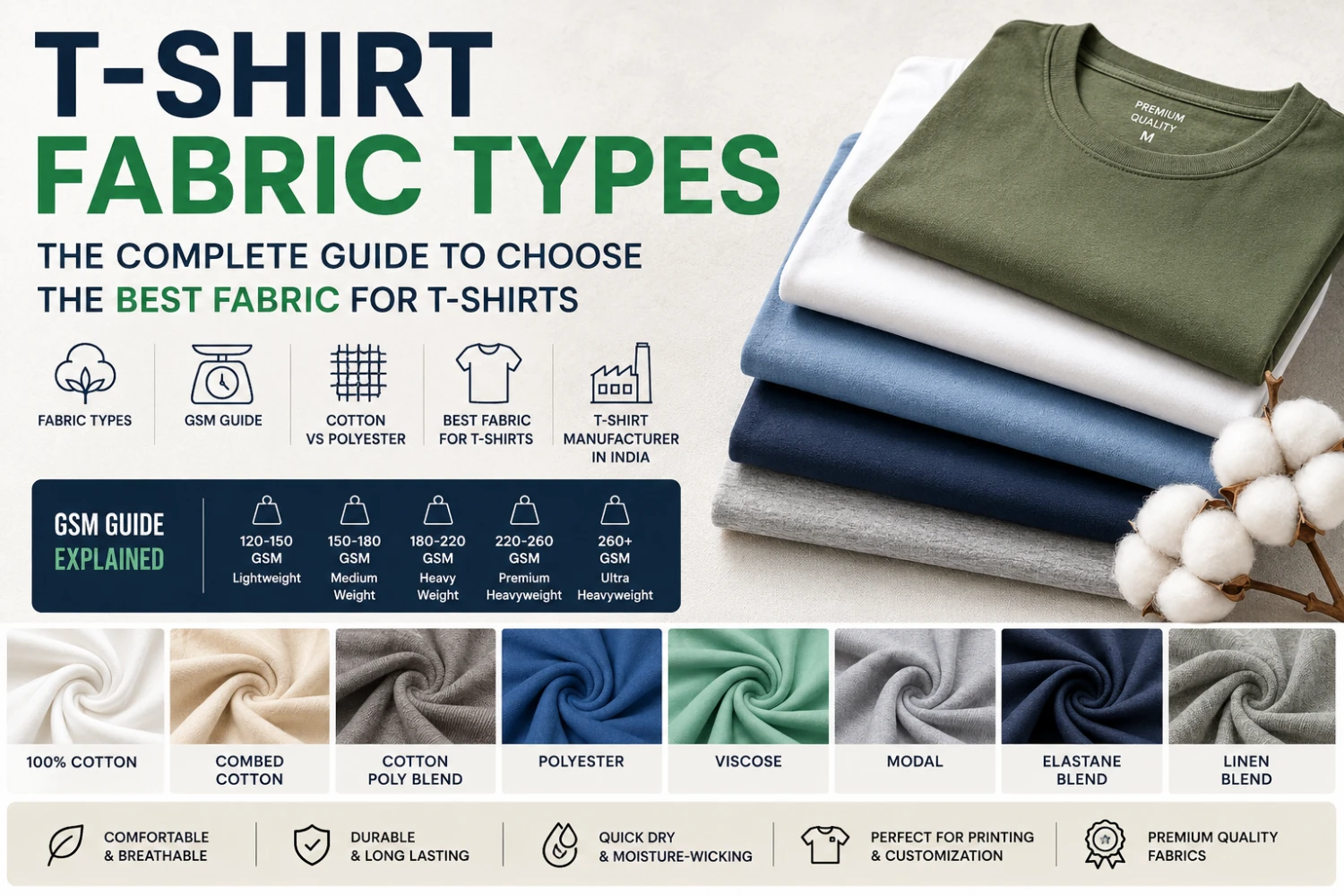
There are many types of fabrics used for T-shirts, including cotton, combed cotton, compact cotton, polyester, cotton-polyester blends, viscose, modal, elastane blends, and different knitted constructions such as single jersey and interlock.
Another important factor is T-shirt fabric GSM. GSM, or grams per square meter, indicates the weight of the fabric and can have a significant impact on the appearance, feel, drape, and durability of a T-shirt.
In this comprehensive guide, we will explain the most common T-shirt fabric types, compare cotton vs polyester, explain T-shirt fabric GSM, discuss the best fabric for T-shirts, and help clothing brands understand how professional manufacturers select fabric.
________________________________________
What Is T-Shirt Fabric?
T-shirt fabric is the textile material used to manufacture the body, sleeves, neckline, and other components of a T-shirt.
Unlike some garments that use woven materials, most traditional T-shirts are made from knitted fabrics. Knitted fabrics are created by forming loops of yarn, which gives them flexibility, comfort, and stretch.
The most common T-shirt construction is single jersey, although other constructions such as interlock and rib are also used.
T-shirt fabric can be manufactured using different fibers, including:
• Cotton
• Polyester
• Viscose
• Modal
• Linen
• Elastane
• Cotton-polyester blends
• Polyester-elastane blends
• Other regenerated or synthetic fibers
The final properties of a T-shirt depend on both the fiber and the fabric construction.
For example, two T-shirts can both be made from cotton but feel completely different because one may use lightweight single jersey while another uses heavyweight compact cotton jersey.
________________________________________
Why Fabric Selection Matters in T-Shirt Manufacturing
Fabric selection affects almost every aspect of the finished garment.
The right fabric can improve:
• Comfort
• Breathability
• Appearance
• Fit
• Durability
• Color retention
• Print quality
• Shape retention
• Shrinkage control
• Overall customer satisfaction
For clothing brands, fabric selection also influences product positioning.
A budget everyday T-shirt requires different specifications from a premium oversized streetwear T-shirt.
Similarly, a sports jersey requires different fabric properties from a casual cotton T-shirt.
This is why a professional plain T-shirt manufacturer does not simply select fabric based on price. The fabric needs to match the intended application.
________________________________________
Different T-Shirt Fabric Types
There is no single fabric that is suitable for every T-shirt. Different fabrics provide different combinations of softness, strength, breathability, stretch, moisture management, and appearance.
Let’s explore the most common T-shirt fabric types.
________________________________________
1. 100% Cotton
Cotton is one of the most popular choices for T-shirt manufacturing.
It is a natural fiber that is widely used for everyday apparel because of its softness, comfort, and breathability.
Cotton T-shirts are especially popular in casualwear, streetwear, promotional apparel, uniforms, and basic clothing collections.
Features of Cotton
• Natural fiber
• Soft hand feel
• Breathable
• Comfortable
• Good moisture absorption
• Suitable for many printing methods
• Available in different weights
Cotton can be manufactured into different yarn qualities and fabric constructions, meaning the quality of a cotton T-shirt can vary significantly.
A basic cotton T-shirt and a premium combed cotton T-shirt may both be labeled “100% cotton,” but their feel and performance can be very different.
Advantages of Cotton
Cotton is comfortable against the skin and works well for everyday wear. It is also a popular fabric for printed T-shirts because many printing technologies work effectively on cotton.
Disadvantages of Cotton
Cotton absorbs moisture and can take longer to dry than many synthetic fabrics. Depending on the fabric and finishing process, cotton garments can also experience shrinkage.
Proper pre-shrinking and finishing can help control dimensional changes.
Best Uses
Cotton is suitable for:
• Regular-fit T-shirts
• Oversized T-shirts
• Casualwear
• Streetwear
• Promotional T-shirts
• Plain T-shirts
• Printed T-shirts
________________________________________
2. Combed Cotton
Combed cotton is a more refined type of cotton yarn.
During the combing process, shorter fibers and impurities are removed, leaving a more uniform collection of fibers for spinning.
This can result in a smoother yarn and a softer fabric surface.
Advantages of Combed Cotton
• Soft feel
• Smooth surface
• Better yarn uniformity
• Premium appearance
• Comfortable for everyday wear
• Excellent for printed garments
Combed cotton is frequently selected by brands looking for a better-quality basic T-shirt.
Best For
• Premium basics
• Fashion brands
• Retail T-shirts
• Branded apparel
• High-quality plain T-shirts
________________________________________
3. Compact Cotton
Compact cotton yarn is produced using a specialized spinning process designed to create more compact and uniform yarn.
The process can reduce yarn hairiness and improve the appearance of the finished fabric.
Benefits
Compact cotton can provide:
• Smooth fabric surface
• Cleaner appearance
• Premium hand feel
• Good fabric uniformity
• Reduced surface hairiness
• Suitable printing surface
It is particularly useful for brands that want a refined and premium appearance.
________________________________________
4. Organic Cotton
Organic cotton is produced according to recognized organic agricultural standards.
It is increasingly used by brands that focus on sustainability and responsible sourcing.
The performance of organic cotton is not automatically superior to conventional cotton simply because it is organic. Its appeal often comes from its production standards, sourcing, and positioning.
Advantages
• Natural fiber
• Comfortable
• Breathable
• Suitable for sustainable collections
• Strong appeal for environmentally conscious consumers
Best For
• Sustainable fashion
• Premium basics
• Eco-conscious brands
• Organic clothing collections
________________________________________
5. Polyester
Polyester is one of the most important synthetic fibers used in T-shirt manufacturing.
It is particularly popular in sportswear because it can provide good durability, shape retention, and quick-drying performance.
Polyester is also commonly used for sublimation printing.
Features of Polyester
• Synthetic fiber
• Durable
• Lightweight options available
• Quick drying
• Low moisture absorption
• Good color retention
• Suitable for performance apparel
Advantages
Polyester can be an excellent choice for activewear because it dries quickly and can maintain its shape during repeated use.
It is widely used for:
• Sports jerseys
• Gym T-shirts
• Football jerseys
• Cricket jerseys
• Running apparel
• Team uniforms
Disadvantages
Polyester does not provide the same natural hand feel as cotton, and odor retention can be an issue depending on the fiber, fabric construction, and finishing.
________________________________________
6. Cotton-Polyester Blend
Cotton-polyester blends combine natural cotton fibers with synthetic polyester.
The exact blend ratio can vary depending on the desired characteristics.
The objective is often to balance cotton’s comfort with polyester’s durability and faster drying.
Advantages
• Comfortable
• Durable
• Better shape retention than some cotton fabrics
• Faster drying than many 100% cotton fabrics
• Versatile
• Suitable for many applications
Best For
• Promotional T-shirts
• Uniforms
• Casualwear
• Workwear
• Everyday T-shirts
• Sports-casual clothing
________________________________________
7. Viscose
Viscose is a regenerated cellulose fiber known for its soft feel and fluid drape.
It can be used alone or blended with other fibers to create lightweight, comfortable fashion garments.
Advantages
• Soft
• Smooth
• Lightweight
• Excellent drape
• Comfortable
• Suitable for fashion apparel
Disadvantages
Viscose can require more careful handling than some synthetic fibers, particularly when wet.
Best For
• Fashion T-shirts
• Lightweight tops
• Premium casualwear
• Summer apparel
________________________________________
8. Modal
Modal is another regenerated cellulose fiber that is known for its softness, smooth surface, and drape.
It is often used in premium apparel and may be blended with cotton or elastane.
Advantages
• Very soft
• Smooth
• Comfortable
• Lightweight
• Excellent drape
• Suitable for premium garments
Best For
• Premium T-shirts
• Luxury basics
• Fashion apparel
• Lightweight garments
________________________________________
9. Elastane / Spandex
Elastane, also called spandex, is a highly stretchable synthetic fiber.
It is usually blended with other fibers rather than being used alone.
For example:
Cotton + Elastane
or
Polyester + Elastane
Adding a small percentage of elastane can improve stretch and recovery.
Advantages
• Excellent stretch
• Good recovery
• Improved comfort
• Suitable for fitted garments
• Useful for sportswear
Best For
• Fitted T-shirts
• Gym wear
• Activewear
• Performance apparel
________________________________________
10. Linen and Linen Blends
Linen is a natural fiber made from flax.
Although it is not as common as cotton for standard T-shirts, linen or cotton-linen blends can be used for lightweight summer clothing.
Advantages
• Breathable
• Lightweight
• Natural
• Suitable for hot climates
• Distinctive texture
Disadvantages
Linen wrinkles relatively easily and can have a more textured appearance than cotton.
________________________________________
11. Bamboo-Based Textiles
Bamboo-based textiles are increasingly marketed as soft and sustainable apparel materials.
However, buyers should understand how the material was processed because many commercial bamboo textiles are regenerated cellulose fibers rather than conventional natural bamboo fibers.
Advantages
• Soft
• Comfortable
• Lightweight options
• Suitable for premium apparel
Best For
• Premium basics
• Sustainable collections
• Fashion apparel
________________________________________
Understanding T-Shirt Fabric GSM
One of the most important specifications when purchasing or manufacturing T-shirts is GSM.
GSM stands for Grams per Square Meter.
It indicates how much one square meter of fabric weighs.
For example, a fabric specified at 180 GSM weighs approximately 180 grams per square meter.
GSM is often used to classify fabrics as lightweight, medium-weight, or heavyweight.
However, GSM should not be considered a direct measurement of quality.
A higher GSM generally means more fabric weight, but quality also depends on yarn, fiber, knitting construction, finishing, and manufacturing.
________________________________________
Common T-Shirt Fabric GSM Range
There is no universal GSM classification, but the following ranges are useful as a general guide:
GSM General Category Common Application
120–150 GSM Lightweight Summer T-shirts
150–180 GSM Light/Medium Everyday T-shirts
180–220 GSM Medium/Heavy Premium basics
220–260 GSM Heavyweight Oversized & streetwear
260+ GSM Very Heavyweight Premium/heavy fashion
These are approximate ranges rather than strict industry rules.
Fabric construction can make two fabrics with the same GSM feel very different.
________________________________________
Why T-Shirt Fabric GSM Is Important
GSM affects several characteristics of the garment.
1. Weight
Higher GSM generally means a heavier fabric.
2. Structure
Heavyweight fabrics can provide more structure and body.
3. Drape
The way fabric falls on the body can change depending on weight and construction.
4. Durability
Higher fabric weight can contribute to durability, although GSM alone does not determine durability.
5. Seasonal Use
Lightweight fabrics are often preferred for hot weather, while heavier fabrics can be suitable for cooler environments and fashion-focused garments.
________________________________________
Lightweight vs Heavyweight T-Shirts
Lightweight T-Shirts
Lightweight T-shirts are generally comfortable for hot weather and casual daily use.
They can provide:
• Lower garment weight
• Comfortable summer wear
• Easy layering
• Good airflow depending on construction
They are often used for promotional clothing and basic everyday apparel.
Heavyweight T-Shirts
Heavyweight T-shirts have become increasingly popular in streetwear and premium fashion.
They can provide:
• Structured appearance
• Premium hand feel
• Stronger silhouette
• More substantial garment weight
• Excellent foundation for oversized fits
A heavyweight T-shirt may be especially suitable for oversized streetwear designs.
________________________________________
What Is the Best Fabric for T-Shirts?
There is no single answer to the question “What is the best fabric for T-shirts?”
The best fabric depends on the purpose of the T-shirt.
Best Fabric for Everyday T-Shirts
Cotton and combed cotton are popular choices because of their comfort and breathability.
Best Fabric for Sports T-Shirts
Polyester is commonly selected for sportswear because of its quick-drying characteristics and suitability for performance applications.
Best Fabric for Oversized T-Shirts
Heavyweight cotton, compact cotton, and suitable heavyweight jersey constructions can provide the structure desired for oversized silhouettes.
Best Fabric for Premium T-Shirts
Combed cotton, compact cotton, modal blends, and other premium constructions can be considered depending on the desired feel and price point.
Best Fabric for Sublimation
Polyester is generally the preferred base for dye-sublimation printing.
Best Fabric for DTF Printing
DTF can be used across a broad range of garments, including cotton, polyester, and many blends, when the transfer materials and application settings are properly matched to the fabric.
________________________________________
Cotton vs Polyester: Which Is Better for T-Shirts?
One of the most common questions in apparel manufacturing is cotton vs polyester.
Both have advantages, but they serve different purposes.
Feature Cotton Polyester
Fiber type Natural Synthetic
Hand feel Soft, natural Smooth/technical
Breathability Generally good Depends on construction
Moisture absorption Higher Low
Drying speed Slower Faster
Sportswear Moderate Excellent
Everyday wear Excellent Good
Sublimation Not suitable for standard sublimation Excellent
Natural feel Excellent Lower
Shape retention Good Generally excellent
Common use Casualwear Sports/performance
Cotton
Choose cotton when comfort, natural hand feel, breathability, and casual styling are the priority.
Polyester
Choose polyester when quick drying, performance, durability, and sportswear functionality are important.
Cotton-Polyester Blend
Choose a blend when you want a balance between comfort and performance.
________________________________________
Single Jersey: One of the Most Popular T-Shirt Fabrics
Single jersey is a knitted fabric construction that is extremely common in T-shirt manufacturing.
It is not a fiber itself.
Single jersey can be made from:
• Cotton
• Polyester
• Cotton-polyester blends
• Viscose
• Modal
• Other fibers
It is popular because it offers flexibility and a comfortable hand feel.
Single jersey is used for both basic and premium T-shirts depending on the yarn, GSM, finishing, and manufacturing process.
________________________________________
Interlock Fabric
Interlock is another knitted construction.
Compared with typical single jersey, interlock generally has a more stable and substantial structure.
It provides a smooth surface and can be used for premium garments.
Common Uses
• Premium T-shirts
• Children’s apparel
• Fashion basics
• High-quality casualwear
________________________________________
Rib Fabric for T-Shirt Necklines
Rib is commonly used for T-shirt collars and cuffs.
The knitted structure provides stretch and recovery, making it suitable for areas that need to fit closely around the body.
A quality neckline is important because it can significantly affect the appearance of a T-shirt.
Even when the main body fabric is excellent, poor collar construction can make the garment look low quality.
________________________________________
Fabric Selection for Different T-Shirt Categories
The following guide can help brands select appropriate materials.
T-Shirt Category Common Fabric Choices
Regular Fit T-Shirt Cotton, combed cotton, blends
Oversized T-Shirt Heavyweight cotton, compact cotton, heavyweight jersey
Sports T-Shirt Polyester
Football Jersey Polyester
Cricket Jersey Polyester
Gym T-Shirt Polyester, polyester-elastane
Premium Basic Combed cotton, compact cotton
Polo T-Shirt Piqué cotton or blends
Summer T-Shirt Lightweight cotton, viscose, linen blends
Stretch T-Shirt Cotton-elastane or polyester-elastane
________________________________________
Best Fabric for Printed T-Shirts
When manufacturing printed T-shirts, fabric and printing technology should be considered together.
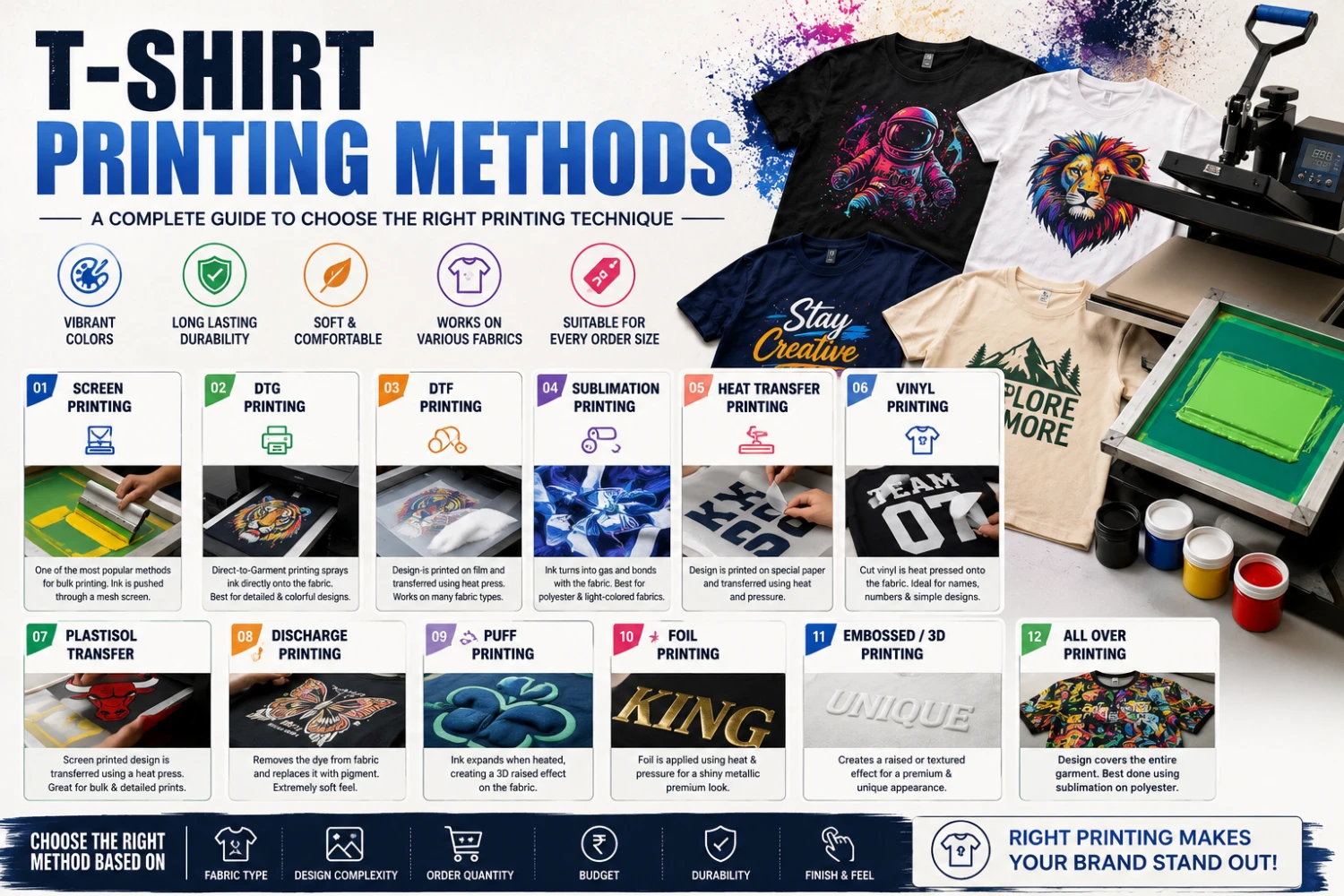
Screen Printing
Cotton and cotton-rich fabrics are commonly used for screen printing.
Screen printing is particularly popular for bulk production.
DTF Printing
DTF printing can be used on cotton, polyester, and many blends.
It is particularly useful for detailed designs and smaller customized orders.
DTG Printing
DTG is commonly used on suitable cotton garments and can produce highly detailed artwork.
Sublimation Printing
Sublimation is particularly suitable for polyester fabrics and is widely used for sportswear and all-over printing.
Therefore, choosing the best fabric for T-shirts also means considering how the garment will be printed.
________________________________________
Fabric Selection for Sports T-Shirts
Sports T-shirts require different properties from casual cotton T-shirts.
A sports garment may need:
• Lightweight construction
• Quick drying
• Moisture management
• Good color retention
• Flexibility
• Durability
• Easy-care performance
Polyester is therefore commonly used for sports jerseys and performance apparel.
For all-over sports designs, polyester is particularly useful because it is compatible with sublimation printing.
________________________________________
Fabric Selection for Oversized T-Shirts
Oversized T-shirts are popular in streetwear and contemporary fashion.
The fabric plays a major role in achieving the desired oversized appearance.
A very lightweight fabric may fall too softly and fail to create a structured silhouette.
Heavyweight jersey or heavyweight cotton can provide:
• Better structure
• Premium appearance
• Stronger drape
• More substantial hand feel
The correct GSM should be selected based on the desired fit and design.
________________________________________
Fabric Selection for Plain T-Shirts
Plain T-shirts are widely used by:
• Clothing brands
• Resellers
• Screen printers
• DTF printing businesses
• Promotional companies
• Corporate buyers
• Schools and organizations
• Fashion startups
A plain T-shirt manufacturer needs to offer fabric options suitable for different applications.
Common choices include:
• 100% cotton
• Combed cotton
• Compact cotton
• Cotton blends
• Polyester
• Heavyweight cotton
• Sports polyester
For blank T-shirts intended for printing, surface consistency is particularly important.
________________________________________
How Fabric Quality Affects Printing
The fabric is not only responsible for comfort. It can also affect print quality.
A good printing base should have a consistent surface and appropriate construction.
Factors that can affect printing include:
• Fiber composition
• Fabric GSM
• Surface smoothness
• Fabric color
• Fabric construction
• Pretreatment
• Moisture content
• Shrinkage
• Finishing
For example, a smooth cotton jersey can provide a good surface for many print applications.
Similarly, polyester sportswear can provide an excellent base for sublimation printing.
________________________________________
How to Choose T-Shirt Fabric for Your Clothing Brand
If you are launching or expanding a clothing brand, fabric selection should be part of the product development process.
Step 1: Define Your Product
Are you making:
• Basic T-shirts?
• Oversized T-shirts?
• Sportswear?
• Premium fashion?
• Promotional apparel?
• Uniforms?
Your answer will narrow down the fabric choices.
Step 2: Decide Your Target Price
Your target retail price influences your manufacturing budget.
A premium T-shirt can justify more expensive yarns, higher GSM, better finishing, and specialized construction.
Step 3: Select GSM
Choose the fabric weight according to the desired fit and application.
Step 4: Select Fiber
Decide between cotton, polyester, blends, or specialty fibers.
Step 5: Test Samples
Never rely only on specifications.
Always evaluate samples for:
• Feel
• Fit
• Shrinkage
• Color
• Stitching
• Printing
• Washing performance
Step 6: Test the Final Garment
A finished garment should be tested rather than evaluating fabric alone.
________________________________________
Why Fabric Shrinkage Matters
Shrinkage is particularly important for cotton garments.
When a T-shirt is washed, fabric dimensions can change depending on the fiber, knitting process, finishing, and garment treatment.
A professional manufacturer should consider shrinkage during production and pattern development.
Pre-shrinking or appropriate finishing processes can help control dimensional changes.
For brands ordering large quantities, shrinkage testing should be performed before bulk production.
________________________________________
Color Fastness in T-Shirt Fabric
Color fastness describes how well a dyed or printed textile maintains its color under different conditions.
Depending on the product, relevant tests may include resistance to:
• Washing
• Rubbing
• Perspiration
• Light
Color fastness is particularly important for clothing brands because fading can negatively affect customer perception.
The dyeing process, fiber type, fabric construction, finishing, and care instructions can all influence color performance.
________________________________________
Fabric Quality vs GSM
A common mistake among buyers is assuming:
Higher GSM = Better Quality
This is not necessarily true.
GSM measures fabric weight, not overall quality.
A 240 GSM fabric can be poorly made, while a 180 GSM fabric can be exceptionally well manufactured.
Quality depends on:
• Fiber quality
• Yarn quality
• Yarn count
• Spinning
• Knitting
• GSM
• Finishing
• Shrinkage
• Color fastness
• Construction
• Manufacturing standards
Therefore, brands should consider the complete specification rather than focusing on GSM alone.
________________________________________
How a T-Shirt Manufacturer in India Selects Fabric
A professional T-shirt manufacturer in India may work with multiple fabric suppliers and specifications depending on customer requirements.
Fabric selection can depend on:
Climate
India has diverse climates, so lightweight breathable fabrics may be suitable for many summer applications, while heavier fabrics can be used for winter and fashion collections.
Product Category
Sportswear, streetwear, corporate uniforms, promotional apparel, and everyday basics have different requirements.
Customer Budget
Manufacturers need to balance quality and cost according to the buyer’s target price.
Printing Method
The fabric needs to be compatible with the intended printing process.
Quantity
Large-scale manufacturing may require consistent bulk fabric availability.
Brand Positioning
A premium fashion label may require higher-quality yarn and finishing than a mass-market promotional product.
________________________________________
What Should You Ask a T-Shirt Manufacturer Before Ordering?
If you are sourcing T-shirts from a manufacturer, ask for detailed specifications.
Important questions include:
1. What is the fabric composition?
2. What is the actual GSM?
3. What yarn is used?
4. Is the fabric pre-shrunk?
5. What knitting construction is used?
6. What finishing process is used?
7. What printing methods are available?
8. What is the minimum order quantity?
9. Can you provide fabric samples?
10. Can you provide a finished garment sample?
11. What customization options are available?
12. What is the production timeline?
13. Can the manufacturer produce consistent quality for repeat orders?
These questions can help you compare manufacturers more effectively.
________________________________________
Why Buying Plain T-Shirts Directly From a Manufacturer Can Be Beneficial
Businesses that require large quantities of blank garments may consider sourcing directly from a plain T-shirt manufacturer.
Direct manufacturing can offer potential advantages such as:
• Custom fabric specifications
• Custom GSM
• Custom colors
• Custom sizes
• Custom labels
• Custom packaging
• Bulk pricing
• Consistent production
• Printing services
Instead of purchasing generic blank T-shirts, brands can work with a manufacturer to develop garments according to their specifications.
________________________________________
Plain T-Shirt Manufacturer vs Wholesaler
A manufacturer produces garments, while a wholesaler generally purchases products from manufacturers or other suppliers and resells them.
A manufacturer may provide greater customization possibilities.
For example, a clothing brand may request:
240 GSM heavyweight cotton + oversized fit + custom neck rib + custom label + custom color.
A manufacturer may be able to develop the garment according to these specifications.
A wholesaler may primarily offer products already in stock.
Both models can be useful, depending on the buyer’s requirements.
________________________________________
How Much Does T-Shirt Fabric Cost?
The cost of fabric depends on many factors, including:
• Fiber composition
• Yarn quality
• GSM
• Fabric construction
• Dyeing
• Finishing
• Order quantity
• Market conditions
• Supplier
• Customization
Therefore, there is no single fixed price for cotton, polyester, or other T-shirt fabrics.
A higher-quality yarn or specialized finish will generally increase the production cost.
For accurate costing, manufacturers should evaluate the complete garment specification rather than calculating price only from GSM.
________________________________________
T-Shirt Fabric for Different Seasons
Summer
For hot weather, brands may prefer:
• Lightweight cotton
• Lightweight jersey
• Viscose
• Linen blends
• Lightweight polyester performance fabrics
Winter
For cooler conditions, brands may use:
• Heavyweight cotton
• Heavy jersey
• Terry fabrics
• Fleece
• Sweatshirt fabrics
Although these heavier materials are not traditional T-shirt fabrics, they are commonly used in related upper-body apparel.
________________________________________
Sustainable T-Shirt Fabrics
Sustainability has become increasingly important in the apparel industry.
Brands may consider:
• Organic cotton
• Recycled polyester
• Regenerated cellulose fibers
• Responsible sourcing
• Reduced-waste production
• Durable garment construction
However, sustainability should be evaluated across the entire product lifecycle.
Factors such as fiber sourcing, manufacturing, dyeing, finishing, transportation, garment durability, and end-of-life disposal can all matter.
________________________________________
Common Mistakes When Selecting T-Shirt Fabric
Mistake 1: Choosing Fabric Only by GSM
GSM does not tell you everything about quality.
Mistake 2: Ignoring Shrinkage
A fabric may feel excellent before washing but change significantly after laundering if shrinkage is not controlled.
Mistake 3: Selecting Fabric Without Considering Printing
Not every fabric is equally suitable for every printing technology.
Mistake 4: Not Testing Samples
Always test samples before committing to large production quantities.
Mistake 5: Focusing Only on Price
The cheapest fabric may not provide the best value if it results in poor durability, comfort, or customer satisfaction.
Mistake 6: Ignoring Fit
The same fabric can look completely different depending on the pattern and garment construction.
________________________________________
Frequently Asked Questions About T-Shirt Fabric
Which fabric is best for T-shirts?
Cotton is a popular choice for everyday T-shirts because it offers comfort and breathability. For sportswear, polyester is often preferred. The best fabric depends on the intended application.
What GSM is best for a T-shirt?
There is no single ideal GSM. Around 150–180 GSM is commonly used for lightweight and everyday T-shirts, while 180–260 GSM and above can be suitable for heavier and oversized styles, depending on construction and design.
Is 180 GSM good for T-shirts?
Yes. 180 GSM can be an excellent weight for T-shirts, depending on the fabric construction, yarn quality, and intended use.
Is 240 GSM too heavy for a T-shirt?
Not necessarily. 240 GSM is considered heavyweight for many T-shirt applications and can work very well for oversized and streetwear garments.
Is cotton better than polyester?
Neither is universally better. Cotton is often preferred for natural comfort and casualwear, while polyester is commonly selected for sportswear, quick drying, and sublimation printing.
Which fabric is best for sports T-shirts?
Polyester is commonly used for sports T-shirts because of its durability, quick-drying characteristics, and suitability for performance apparel.
Which fabric is best for oversized T-shirts?
Heavyweight cotton, compact cotton, and heavyweight jersey are popular choices for oversized T-shirts because they can provide structure and a substantial appearance.
What does GSM mean in T-shirts?
GSM means grams per square meter. It indicates the weight of the fabric and is commonly used to describe whether a fabric is lightweight, medium-weight, or heavyweight.
Is higher GSM always better?
No. Higher GSM means greater fabric weight, but it does not automatically mean higher quality. Yarn, fiber, construction, finishing, and manufacturing quality also matter.
Which fabric is best for sublimation printing?
Polyester is generally the preferred fabric for dye-sublimation printing because the process works particularly well with polyester fibers.
Which fabric is best for DTF printing?
DTF can be used on many cotton, polyester, and blended fabrics. The transfer material and application process should be matched to the garment.
Which fabric is best for screen printing?
Cotton and cotton-rich fabrics are commonly used for screen printing, although screen printing can be applied to many other suitable textile materials.
________________________________________
Final Guide: Choosing the Right T-Shirt Fabric
Choosing the right T-shirt fabric is about more than selecting cotton or polyester.
A professional buyer should consider:
Fiber + Yarn + Construction + GSM + Finishing + Fit + Printing + Application
For everyday casual T-shirts, cotton and combed cotton remain popular choices.
For premium and oversized T-shirts, heavyweight and compact cotton constructions can provide the desired structure and premium feel.
For sportswear and performance apparel, polyester is widely used.
For stretch garments, elastane blends can provide additional flexibility.
For lightweight fashion apparel, viscose and modal can provide softness and drape.
The right combination depends on what you want the final T-shirt to achieve.
________________________________________
Conclusion: Finding the Best Fabric for Your T-Shirt
Understanding T-shirt fabric types is essential for anyone involved in clothing manufacturing, fashion, wholesale, printing, or retail.
Cotton, combed cotton, compact cotton, polyester, cotton-polyester blends, viscose, modal, elastane, linen, and other materials each have their own characteristics.
At the same time, fabric construction matters just as much. Single jersey, interlock, rib, and other knitted structures can create very different garment experiences.
T-shirt fabric GSM is another important specification. Lightweight fabrics can be ideal for summer and promotional apparel, while heavyweight fabrics can be suitable for oversized T-shirts and streetwear. However, GSM should never be treated as the only indicator of quality.
When comparing cotton vs polyester, remember that both materials have their own strengths. Cotton is widely preferred for comfortable everyday apparel, while polyester is particularly useful for sportswear and performance garments.
If you are searching for the best fabric for T-shirts, start by defining your product category, target customer, desired price, fit, printing method, and performance requirements.
For businesses looking for a reliable T-shirt manufacturer in India, working directly with an experienced manufacturer can make it easier to discuss fabric composition, GSM, colors, fit, printing, labels, packaging, and bulk production requirements.
Looking for a Plain T-Shirt Manufacturer?
MountCart provides T-shirt manufacturing and printing solutions for clothing brands, businesses, sports teams, resellers, and bulk buyers.
Whether you need plain T-shirts, oversized T-shirts, sports T-shirts, custom T-shirts, DTF printing, sublimation printing, or bulk apparel manufacturing, selecting the right fabric is the first step toward building a quality product.
A successful T-shirt starts with the right fabric—but great manufacturing brings the entire product together.
Recent Posts
T-Shirt Fabric Types: Complete Guide to the Best Fabric for T-Shirts, GSM, Cotton vs Polyester & More
TeesWarrior – Redefining Streetwear Fashion in India

Subscribe to our newsletter for regular updates about Offers, Coupons & more